I have spent much of my academic career writing about Ethiopia and the Horn of Africa. I wish I could say that my concerns today are exaggerated. I do not believe they are.
The warning signs that preceded the war in Tigray are returning with alarming speed. Political divisions inside Tigray have deepened. Relations between Ethiopia and Eritrea have deteriorated dramatically. Armed conflict continues elsewhere inside Ethiopia. Sudan is already consumed by war. And Prime Minister Abiy Ahmed has repeatedly presented Ethiopia’s demand for direct access to the Red Sea as something approaching an existential national question. Eritrea understandably hears such language very differently from Addis Ababa. In February, Reuters reported that Ethiopia formally accused Eritrea of military aggression and support for armed groups, while Eritrea rejected the accusations as fabricated.
More worrying is that this is no longer only a war of words.
In January, federal and Tigrayan forces fought again for the first time since the Pretoria Agreement brought the 2020-2022 war to an end. Ethiopian Airlines suspended flights to Tigray amid the clashes, and a federal drone strike later that month killed one person and injured another. By February, Le Monde was reporting large Ethiopian military deployments around Tigray, with one security source describing the region as effectively encircled.
Then came Shererina.
The fighting that erupted there on August 1 should not be treated as just another border skirmish. Al Jazeera described the clashes in western Tigray as one of the most serious threats yet to the Pretoria peace. Other reporting placed the fighting around Shererina, close to the Sudanese border, and described the use of heavy artillery and drones.
There is a widely discussed interpretation of Shererina that deserves serious attention. The confrontation may have been a test by the federal government: an attempt to find out how much military capacity the Tigray Defence Forces still possessed after years of political division, economic pressure and incomplete implementation of Pretoria. Journalist Martin Plaut has made precisely this argument, describing Shererina as a deliberate test of competing military and political narratives.
If that was the intention, the answer appears to have surprised Addis Ababa.
Accounts from the Tigrayan side describe heavy federal losses, wounded soldiers and large numbers of prisoners. Those numbers remain difficult to verify independently, so they should be treated cautiously. But the larger point is harder to dismiss: the TDF did not collapse under pressure.
That matters.
For several years, Addis Ababa has had reason to assume that time was working against Tigray. The region remains economically devastated. Its political leadership has split. The TPLF lost its legal status as a political party. Federal authorities retained enormous influence over the interim political arrangement created after Pretoria. Budget transfers were repeatedly interrupted, salaries went unpaid, public services deteriorated and reconstruction remained painfully slow. A July 2026 country-of-origin assessment by Belgium’s refugee authorities described Tigray as suffering continuing economic disruption, repeated suspensions of budgetary transfers and long delays in salaries for teachers and civil servants.
The assumption may have been that political fragmentation and economic exhaustion would eventually produce military weakness.
Shererina suggests otherwise.
If the operation was meant to probe the TDF, it may instead have demonstrated that Tigray’s capacity for organised resistance remains substantial. That does not make renewed war less dangerous. It may make it more dangerous.
Addis Ababa could draw the sensible lesson: another ground war in Tigray would be extraordinarily costly.
Or it could draw the opposite lesson: if ground operations are difficult, rely more heavily on drones, economic pressure and political isolation.
The recent pattern gives reason for concern. Federal air attacks on Tigrayan positions had already resumed by June, including strikes around Shererina and Sheraro. On August 10, Tigrayan authorities accused the federal government of another drone strike at Merewa in southern Tigray.
The danger is therefore no longer simply that another war might begin. The distinction between preparation for war and the opening stages of war is becoming increasingly difficult to make.
Pretoria stopped the war. It did not build peace.
Less than four years ago, the world celebrated the Pretoria Agreement for ending one of the bloodiest conflicts of this century.
It undoubtedly saved lives.
But stopping fighting and building peace are not the same thing.
Pretoria left crucial questions unresolved. Western Tigray remained outside the control of the Tigrayan administration. Hundreds of thousands of displaced people remained unable to return home. Reconstruction lagged far behind the destruction. Questions of political representation, territorial administration and accountability were left hanging. As recently as July 2026, more than 700,000 internally displaced people were still unable to return, according to the Belgian country assessment.
Peace agreements often fail this way. They do not necessarily collapse in a dramatic moment. They erode. Deadlines pass. Temporary arrangements become permanent. Political questions are postponed. The international mediators congratulate themselves and move on.
That is what happened with Pretoria.
The greatest responsibility lies with Prime Minister Abiy Ahmed because responsibility must also be measured against power.
After Pretoria, Addis Ababa controlled the federal institutions through which Tigray could either be restored to normal political and economic life or kept in a condition of dependency.
Instead, the interim arrangement became increasingly political.
When Getachew Reda left the Tigray Interim Administration in 2025, Abiy himself appointed Tadesse Worede to replace him.
At the same time, the TPLF remained outside normal federal political participation. Tigray did not participate in Ethiopia’s June 2026 national election. Reuters reported that no election was held in Tigray, while Abiy’s Prosperity Party went into the election facing a weak and fragmented national opposition.
Seen in this context, Debretsion Gebremichael’s decision in May to restore Tigray’s pre-war legislative council and regional government cannot simply be dismissed as the act of a reckless hardliner trying to destroy Pretoria.
The TPLF said it was responding to federal violations of the agreement, including the withholding of money needed to pay civil servants and the unilateral extension of the interim administration.
That does not settle the argument. But it changes it.
The question is not simply whether Debretsion complied with an interim arrangement. The question is whether an interim arrangement can remain legitimate indefinitely when the political organisation with the strongest roots in Tigray is denied normal political participation and Addis Ababa retains decisive influence over who governs the region.
An interim government is supposed to be interim.
Pretoria was supposed to provide a bridge back to politics. It was never meant to give Addis Ababa a permanent right to decide which Tigrayans were acceptable enough to govern Tigray.
Economic strangulation
The economic side of this story receives far too little attention.
Some services returned after Pretoria. Flights resumed. Telecommunications came back. Banks reopened.
Those things mattered.
But restoring telephone service is not the same thing as restoring an economy.
Tigray emerged from the war devastated. Hospitals, schools, factories, farms and businesses had been destroyed or badly damaged. Hundreds of thousands of people remained displaced. Families needed access to savings and credit. Civil servants needed salaries. Reconstruction required money on a scale far beyond what the region itself could provide.
Instead, financial pressure continued.
The result increasingly resembles economic strangulation.
That phrase does not require us to prove the existence of some secret written order in Addis Ababa instructing officials to starve Tigray economically. The cumulative effect is what matters.
If federal transfers are repeatedly interrupted, civil servants cannot be paid, banks lack liquidity, reconstruction stalls and a region devastated by war is denied the resources required to recover, economic weakness becomes political power.
A regional administration that cannot pay teachers, operate hospitals or rebuild basic infrastructure does not enjoy meaningful autonomy, whatever the constitution says.
And this matters for understanding why political positions inside Tigray have hardened.
People were told that Pretoria would bring peace.
What many experienced instead was peace without recovery, political normalisation or return home.
That changes the meaning of restraint.
Who exactly are Washington’s “hardliners”?
This brings us to the United States.
On June 18, Washington announced targeted visa restrictions against people seen to be TPLF “hardliners”, accusing them of undermining peace and threatening to reignite conflict.
The language deserves much more scrutiny than it received.
If Debretsion Gebremichael and those around him are the hardliners, who exactly are the soft-liners?
Washington did not say.
But the political implication is difficult to miss.
The figures most often treated outside Tigray as pragmatic alternatives to Debretsion include Getachew Reda and Lt. Gen. Tsadkan Gebretensae. Yet that distinction looks very different from inside Tigray.
Getachew, in particular, has become deeply controversial. His break with Debretsion’s faction was followed by his departure from Tigray and his eventual role advising Abiy Ahmed.
The contradiction became painfully visible when Mehdi Hasan interviewed Getachew on Head to Head. Hasan pressed him on how someone who had accused Abiy’s government of atrocities in Tigray could later become an adviser to the same prime minister.
That interview was embarrassing because Getachew never really escaped the contradiction.
But something even more revealing happened later.
On June 11, just one week before Washington announced its visa restrictions, Getachew published an extraordinary joint Al Jazeera opinion piece with Redwan Hussein, one of Abiy Ahmed’s most important national-security officials and a central federal negotiator at Pretoria. Their article placed much of the blame for the deterioration of the peace on what they repeatedly called TPLF “hardliners.”
A week later, Washington was using essentially the same political vocabulary.
There is no evidence that the United States simply took its language from Getachew and Redwan, and it would be wrong to imply coordination without evidence.
But the timing is striking.
More important is the analytical problem.
A politician does not become a moderate simply because he is willing to work with Addis Ababa.
Nor does someone become a hardliner simply because he refuses to accept the political arrangement Addis Ababa prefers.
A politician can sound moderate in Washington or Addis Ababa and have very little political credibility in Mekelle.
That is the problem with treating Getachew, Tsadkan or others close to the federal government as some obvious moderate centre.
Significant parts of Tigrayan society and the diaspora do not see these figures as moderates. They see them as having crossed over politically to Abiy’s side. Whether every accusation made against them is fair is beside the point. Political legitimacy does not come from Washington.
And peace cannot be built around representatives whom large numbers of the people they are supposed to represent do not trust.
If Washington is catering to politicians because they are easier for Addis Ababa and foreign diplomats to work with, it is doing a disservice to the cause of peace.
The United States cannot manufacture a moderate centre.
The visa threat was hollow
There is another problem with the American approach.
The visa restrictions apparently did not frighten the TPLF.
Why would they?
For political leaders who believe their society remains economically strangled, politically marginalised and threatened again militarily, the possibility of losing access to the United States is a hollow threat.
What exactly is Washington threatening to take away?
For people who believe that displaced families cannot return home, their regional economy is being suffocated and their political future is being determined from Addis Ababa, American travel privileges are hardly the central question.
There is a more dangerous possibility.
The American action may have sent a different message to the Prosperity Party.
By publicly identifying TPLF hardliners as the principal threat while saying much less about the federal government’s contribution to the deterioration of Pretoria, Washington may have given Addis Ababa the impression that it had diplomatic room to push harder.
That does not mean Washington caused Shererina. There is no evidence for such a direct claim.
But diplomacy is partly about signals.
Governments look at what powerful states condemn, what they tolerate and whom they punish.
The United States should have understood this better than most because it was one of the most important international actors supporting the diplomatic process that culminated in Pretoria.
A sponsor of a peace agreement has to be particularly careful not to create the impression that one side has diplomatic cover.
Seen in that light, Shererina raises an uncomfortable possibility.
The American warning did not scare the TPLF.
It may have emboldened the Prosperity Party.
And Shererina may be where those two calculations met.
A regional war would not resemble 2020
There is another reason this moment is so dangerous.
A new war would not simply be a replay of the Tigray war that began in 2020.
The alliances have changed.
During that war, Ethiopia and Eritrea fought together against the TPLF. Today their relationship has deteriorated so dramatically that Ethiopia publicly accuses Eritrea of supporting armed groups hostile to Addis Ababa, while Eritrea accuses Ethiopia of using such claims to prepare the ground for aggression.
At the same time, conflict continues in Amhara and Oromia.
Sudan is already engulfed in civil war.
And the Red Sea has become an even more crowded geopolitical arena. Reuters reported earlier this year that competition involving Saudi Arabia, the UAE, Egypt, Turkey and Qatar has reshaped alignments across the Horn.
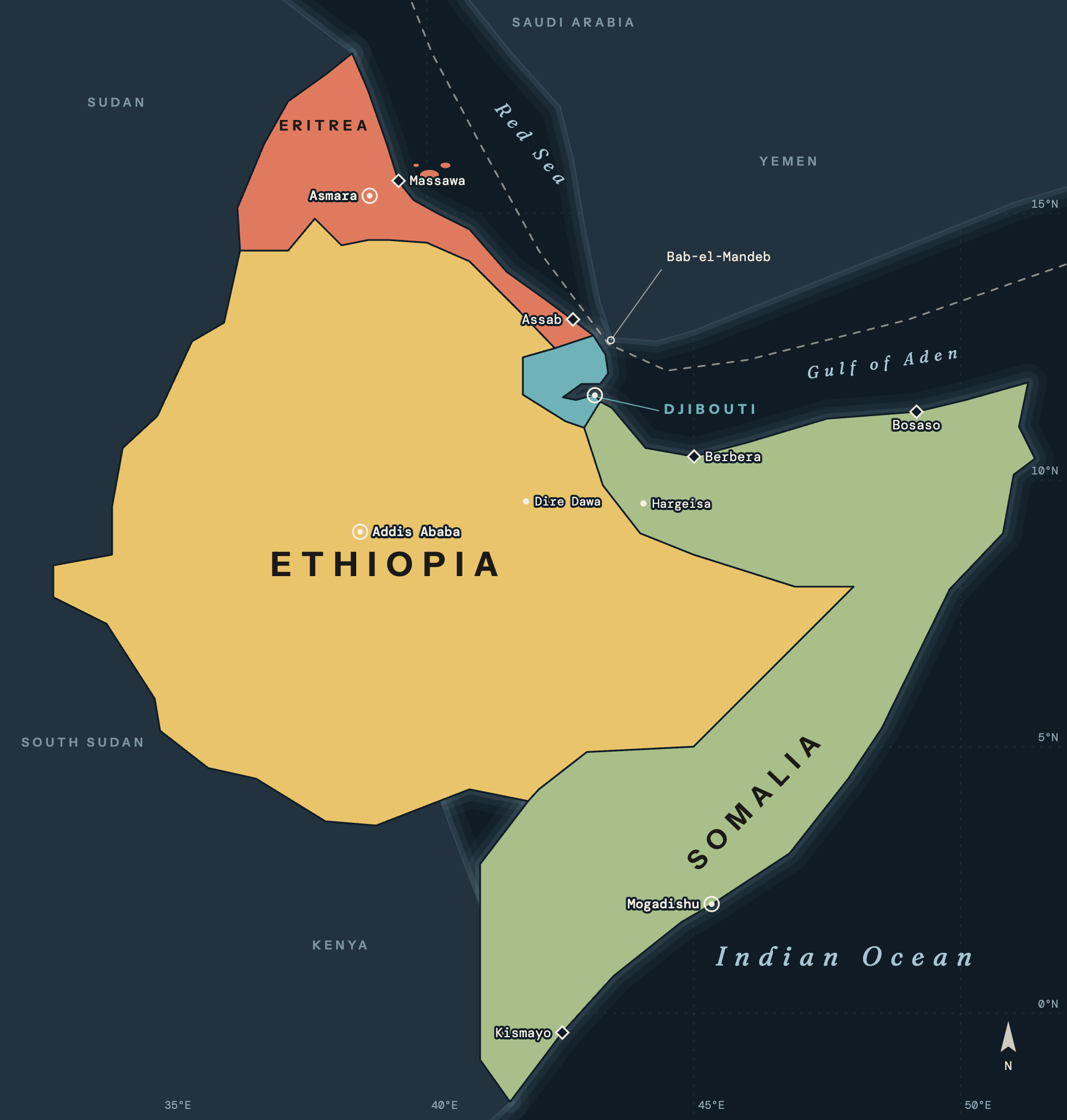
Against this background, Abiy’s repeated campaign for direct access to the Red Sea becomes particularly dangerous.
Ethiopia has legitimate economic interests in affordable and dependable port access.
But commercial access and sovereignty are not the same thing.
Assab is not an abstract coastline waiting for Ethiopia to reclaim it. It is sovereign Eritrean territory.
That distinction should be obvious, especially after the catastrophic 1998-2000 Ethiopia-Eritrea border war.
Instead, the rhetoric of sea access has increasingly been presented in Ethiopia as something connected to national destiny.
That transforms an economic issue into a territorial one.
Tigray now sits directly in the middle of that emerging confrontation.
A region that Pretoria was supposed to remove from the centre of regional war could once again become the geographical hinge connecting an Ethiopian internal conflict to an Ethiopia-Eritrea confrontation.
And this time the war could intersect with armed actors in Amhara, developments in Sudan and competing external powers across the Red Sea.
That is what makes the present moment more dangerous than it first appears.
Diplomacy is behind events
The international response still seems to assume that the main task is to protect Pretoria.
But Pretoria is not a museum exhibit.
Its purpose was to produce a political settlement.
If the underlying settlement is not working, repeating the words “implement Pretoria” will not save it.
Washington’s “hardliner” language is a good example of the problem. It focuses on personalities instead of asking why positions are hardening.
That is the question outsiders should be asking.
Why would people who survived one of the most destructive wars in recent African history risk another one?
Why would a population that desperately wanted peace become increasingly willing to contemplate renewed confrontation?
The answer may be that peace has not delivered what they believed peace was supposed to deliver.
Displaced people are still displaced.
Territorial disputes remain unresolved.
The region’s economy remains crippled.
Tigray was excluded from the federal election.
Its main political organisation was denied normal political participation.
Federal influence over the interim administration remained substantial.
And now drones and artillery have returned.
Under those circumstances, telling Tigrayans that their leaders should simply behave more moderately misses the point.
The appropriate question is not: Who are the hardliners?
It is: What is producing the hardening?
The United States, European Union and African Union need to return to that question quickly.
Economic normalisation must mean more than reopening flights and telecommunications. Tigray needs predictable financing, functioning banks and serious reconstruction.
Political normalisation must mean more than maintaining an interim administration indefinitely. Tigray needs a credible path back into federal political life.
The territorial question cannot simply be postponed forever.
And diplomacy now has to include Eritrea because the security environment that existed when Pretoria was signed no longer exists.
There is still time to prevent another catastrophe.
But much less than there was a year ago.
I hope I am wrong about where this is heading.
Nothing would please me more than to read these words several years from now and discover that I had exaggerated the danger.
But hope is not a policy.
Shererina should be treated as a warning.
It may have shown Addis Ababa that Tigray is not as militarily weak as it assumed. It may have shown the TDF that it can still resist the ENDF. And it may have shown both sides that the military balance remains unsettled.
That is not reassuring.
The Pretoria Agreement stopped a war. It did not finish the work of peace.
Today the unresolved political questions, economic pressures, territorial disputes, drone strikes, military mobilisation and changing regional alliances are coming together again.
If another devastating war follows, nobody will be able to say the warning signs were invisible.
They are visible now.
Yohannes Woldemariam is a writer and commentator on the Horn of Africa. He previously coauthored analyses of Ethiopia’s democratic transition and questions of state legitimacy.