

As the ballots are counted in Ethiopia’s 2026 general elections, government officials present the vote as evidence that the country has turned a corner. More than 50 million voters have reportedly registered, the war that devastated Tigray has formally ended, and international attention is increasingly focused on economic recovery rather than political conflict. From a distance, Ethiopia may therefore appear to be moving beyond the crises that have dominated its politics for much of the last decade.
Yet this impression is misleading. As in the past, the government moved to hold elections before resolving many of the conflicts that have driven instability and undermined national cohesion. Elections can allocate power, but they cannot create the political settlement necessary to hold together a deeply divided society.
When Abiy Ahmed came to power in 2018, he generated extraordinary optimism at home and abroad. The release of political prisoners, the return of exiled opposition figures, the opening of political space, and the peace agreement with Eritrea created expectations that Ethiopia might finally begin a transition away from decades of authoritarian rule and political exclusion. In 2021, however, myself and my co-author, DiA’s Nic Cheeseman, warned that this opening was flawed – and that the country’s upcoming elections could do more harm than good.
At the time, many observers still believed that the violence, polarization, and institutional breakdown then emerging would prove temporary setbacks rather than defining features of the political system.
Looking back, we underestimated how quickly political fragmentation would outpace institutional reform, and how difficult it would prove to build durable democratic institutions while armed conflict, ethnic polarization, and competing claims to legitimacy continued to shape Ethiopian politics.
Five years later, the positive expectations of Abiy’s tenure have largely faded. The question facing Ethiopia is no longer whether democratic reform can be revived, but whether the country can build a sufficiently inclusive and credible political settlement to prevent instability from becoming a permanent feature of national life.
The illusion of normality
The international community increasingly treats Ethiopia as a country moving away from conflict. Yet one of the greatest analytical mistakes being made today is to mistake the absence of civil war for peace or stability. The absence of large-scale war is not the same thing as the presence of a feasible political settlement.
The Pretoria Agreement ended the devastating conflict in Tigray, but Ethiopia remains volatile. Violence continues in parts of Amhara and Oromia, while many of the political disputes that fuelled conflict remain unresolved. Ethiopia did not hold elections after resolving its conflicts. Rather, it held elections while many of those conflicts continued.
The exclusion of Tigray from the electoral process illustrates this reality. A national election intended to confer democratic legitimacy proceeded without the participation of an entire region.
Voting was also suspended in parts of Amhara because of insecurity, while large numbers of Ethiopians remain displaced or affected by conflict. Under such circumstances, it is difficult to argue that the election represents a fully national democratic exercise.
The persistence of conflict outside Tigray reinforces this challenge. Fighting between federal forces and Fano militias continues in parts of Amhara, while violence involving the Oromo Liberation Army remains a feature of politics in parts of Oromia. Although these conflicts are smaller than the war in Tigray, they continue to generate insecurity, displacement, and political distrust.
The Shrinking Space for Politics
The challenge facing Ethiopia extends beyond conflict. It also concerns the gradual erosion of trust in public institutions and the narrowing of political competition.
Organizations such as Amnesty International, Human Rights Watch, the Committee to Protect Journalists, and Freedom House have documented growing concerns regarding civic space, press freedom, and political rights. Independent journalists describe increasing pressure, intimidation, surveillance, and self-censorship. The government disputes aspects of these assessments, often citing security concerns. Yet the cumulative effect has been to weaken confidence that political competition can take place on an equal footing.
Many of the political actors who shaped the optimism of 2018 are no longer active participants in Ethiopian politics. Some have been imprisoned, exiled, or withdrawn from public life altogether.
Opposition parties continue to exist, but many operate under severe organizational, financial, and security constraints. Several prominent movements have spent years navigating legal restrictions, internal fragmentation, armed conflict, or exile. The cumulative effect has been a narrowing of the political arena and a weakening of meaningful competition.
The problem extends beyond political competition. Increasingly, government officials, opposition figures, journalists, international organizations, and ordinary citizens appear to inhabit different political realities. The result is not merely disagreement but the erosion of a shared factual foundation upon which democratic politics depends. Ethiopia’s crisis is therefore not only a crisis of governance. It is increasingly a crisis of credibility.
Why the Election Will Not Resolve Ethiopia’s Crisis
As expected, Prime Minister Abiy Ahmed’s Prosperity Party appears to have secured another overwhelming parliamentary majority, with early results showing the ruling party winning the vast majority of the more than 800 constituencies declared so far. But this result will do little more than paper over the cracks of the country’s broken political settlement.
Concerns about the risk of further political instability have been made more significant by changes in the international environment. During the early years of Abiy Ahmed’s government, democratic opening was strongly encouraged by external partners. Today, the balance of international priorities has shifted.
Human rights organizations continue to warn about democratic backsliding and shrinking civic space. Yet many external actors increasingly engage Ethiopia through the lens of economic reform, debt restructuring, migration management, regional stability, and Red Sea security.
This shift is visible in both Europe and the United States. Whereas international engagement once placed greater emphasis on governance and political reform, strategic interests increasingly dominate diplomatic calculations. The result is a perception that international actors are less willing than before to exert pressure for democratic reforms or electoral accountability. Recent statements by senior US officials have reinforced the sense that stability and strategic interests now take precedence over democracy promotion in international engagement with the region.
This matters because Ethiopia’s underlying challenges remain unresolved. Violence continues in parts of Amhara and Oromia, while Tigray remains outside the electoral process. Political competition has narrowed, civic space has come under pressure, and trust in public institutions has weakened. At the same time, domestic instability is increasingly intertwined with regional tensions.
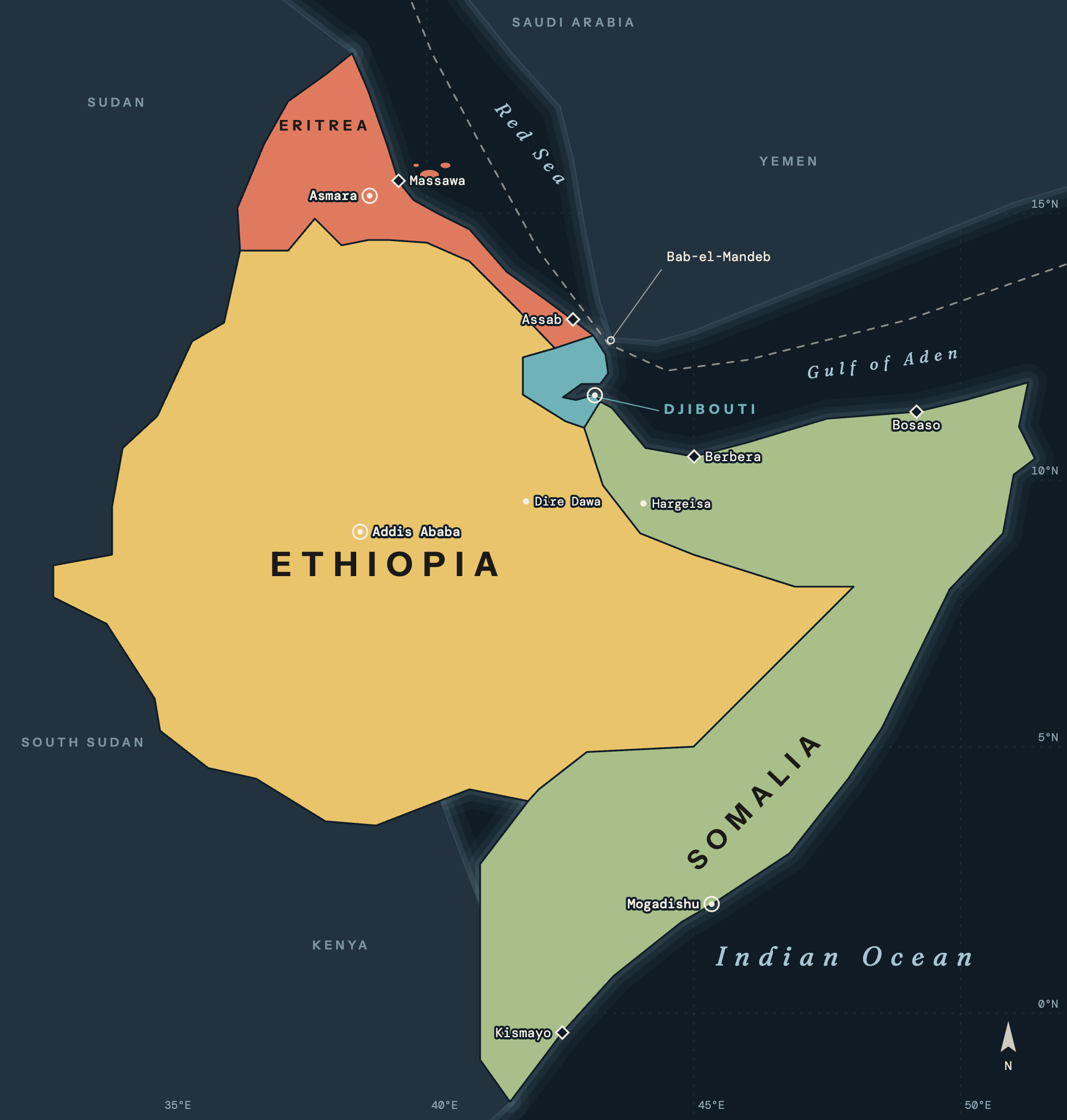
Relations with Eritrea have deteriorated sharply, concerns about renewed conflict have grown, and disputes involving Somalia, Somaliland, and access to the Red Sea have raised the stakes still further. The result is a political environment in which unresolved internal divisions risk spilling across borders – and vice versa.
The danger is therefore not simply hardening authoritarianism. It is the growing gap between the appearance of political normalization and the reality of continued fragmentation. Elections can confer authority, but they cannot by themselves create trust, resolve disputes over federalism, or reconcile competing visions of the Ethiopian state.
For much of the last decade, debates about Ethiopia have focused on war, democratic reform, and economic recovery. Yet progress in each of these areas ultimately depends on the same underlying issue: whether the country can forge a political settlement capable of commanding broad legitimacy across its diverse regions and communities.
Millions of Ethiopians have now lived through war, displacement, inflation, political repression, and repeated national emergencies. Exhaustion has become a defining political condition. Until the underlying questions of peace, representation, federalism, civic freedoms, and institutional credibility are addressed, the country’s legitimacy crisis will continue long after the votes have been counted.
Yohannes Woldemariam is a writer and commentator on the Horn of Africa. He previously coauthored analyses of Ethiopia’s democratic transition and questions of state legitimacy.